Mine site sensor set to boost rare-earth recoveries
An Adelaide-based quantum technology company will receive $2.4 million from the Australian Government to develop the nation’s first real-time mine-site sensor to measure recoverable rare-earth elements in clay deposits. Via Australian Mining

Rare earths. Image: Annamorphosis/stock.adobe.com
TeraGlo will receive the funding as part of the first round of the second stage of the government’s critical technologies challenge program, where a total of $12.7 million is funding eight quantum technology projects.
Formed through the collaboration between Loughan Technology Group (now known as TeraGlo) and the University of Adelaide, Institute for Photonics and Advanced Sensing, the technology revolves around quantum artificial intelligence material sensing (QAIMS).
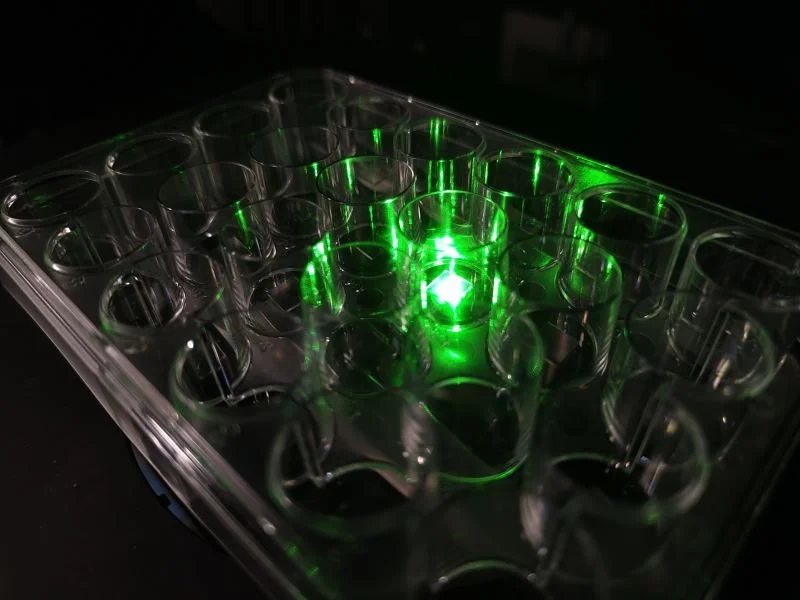
QAIMS works through novel fluorescence (NF), where multiple light sources at different colours target specific materials to then emit characteristic colour signatures.
Termed ‘fluorescence’, these signals are specific to each material, enabling detection, speciation, and quantification of target materials in complex mixtures, in addition to imaging of the sample shape, form, size, and structure.
TeraGlo’s main QAIMS products include portable analysers, with each handheld instrument custom-configured for the application and use and incorporating on-board data processing, a graphic user interface, and direct cloud connectivity.
The company also has online analysers, where its sensor package is integrated, including over-belt scanning, ore-sorting, and online liquid and slurry analysers.
TeraGlo also utilises the up-conversion fluorescence, or the anti-Stokes fluorescence, as a process where two or more lower-energy photons are absorbed sequentially, leading to the emission of a higher-energy photon, or a shorter wavelength.
“One of the major advantages of NF is the imaging capability,” TeraGlo said.
“Most compound phase detection (or mineralogy) techniques provide only a spectral response.NF as an imaging technique can provide full sample morphology including shape, form, size, and structure.”
The government’s critical technologies challenge program aligns with the Future Made in Australia plan by backing Australian-led projects that deliver innovations in science and digital capability. By nurturing quantum capabilities, the program look to strengthen Australia’s high-tech manufacturing base for the future.
Related articles